Showing posts with label religion. Show all posts

Saturday, April 6, 2019

Deepak Chopra's Enlightenment series

Deepak Chopra's Enlightenment series tells semi-historical fictional tales of several key religious figures: Buddha, Jesus, and Muhammad.

Buddha: A Story of Enlightenment
Let me say right up front that I have no interest in Chopra except as a storyteller. He's got some really strange ideas about "quantum healing" that can be dangerous when people abandon real medical treatments to pursue them. He puts way too much stock in the ability of the mind to influence the body and the world around you. His views on spirituality and religion are centered on the human mind, not the divine (although he might argue they're the same). I have zero interest in any of that.

So why read these books? I like to think that I'm open-minded enough to consider a story (or any other work of art) on its own merits, not pre-judge based on the person on the dust jacket. Historical fiction based on key religious figures is an interesting concept, and I'd been looking for books that fit into the time periods of the lives of those figures. In a way, this is another form of my love of alternate history...just slightly different subject matter than the usual wars and political intrigue.

Buddha is a story in three parts: the birth and early life of prince Siddhartha, his abandonment of wealth and status to live as the ascetic monk Gautama, and finally his enlightenment as Buddha. The book ends just as his teaching years were beginning, which made sense to me - as I understand it, he taught for nearly 45 more years and that could be an entire other book. It's a personal story, following Siddhartha/Gautama/Buddha on his journey to enlightenment, with little focus on Buddhism as a religion (other than an explanatory epilogue). Chopra kept the story moving throughout, and the Indian cultural and religious references were fascinating.

Jesus is set during his early life, before the ministry set forth in the gospels. Jesus falls in with zealots plotting rebellion against the Romans, Gentiles searching for God, even a holy ascetic. Rather than the perfect faith of Jesus in the Bible, this Jesus is unsure much of the time, but finds his way by learning acceptance of God in all things. I thought the story really captured the feel of the times; the average Jew just trying to stay alive and fed, the Romans trying to keep the lid on a rebellious province, the zealots pushing so hard for freedom that they'd pay any price.

Muhammad uses the perspective of many different people who were close to Muhammad at various points in his life to tell his story, from close relatives to family servants to business partners. The picture that emerges is a serious and kind man, but certainly not a great leader or orator. Until an angel comes to Muhammad, and changes his life by giving him the command to recite. It's not easy to go against his nature, first as a speaker, then a leader, and in the end becoming a warrior and ruler. This portrayal was a more difficult one to accept than that of Buddha or Jesus, in my opinion; Muhammad's direct involvement in holy wars makes the picture of an enlightened leader much less believable.

I think that a reader's reaction to these books is going to depend entirely on mindset. I approached them as stories that happened to feature some familiar characters and settings, and in that I was not disappointed. Chopra is a fine storyteller, whatever you may think about his beliefs. But if you expect adherence to the orthodox portrayal of these religious figures, or deep spiritual insights into their stories, you're looking in the wrong place.

Wednesday, June 21, 2017

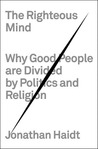
The Righteous Mind by Jonathan Haidt

The Righteous Mind: Why Good People are Divided by Politics and ReligionThe Righteous Mind: Why Good People are Divided by Politics and Religion by Jonathan Haidt
My rating: 4 of 5 stars

I picked up The Righteous Mind: Why Good People are Divided by Politics and Religion by Jonathan Haidt from the library recently. It was recommended by the Make Me Smart podcast, which I listen to regularly.

Seeing the term "righteous" in the title immediately made me think of this as a religious book, but that's not really the case. The theme of the book is morals and ethics, and of course religion does play a role, but not a major one. The author explains the use of "righteous" in his introduction as an intentional way to point out that the human mind is not just moral, but also judgmental and critical and intolerant (as in "self-righteous").

That's something of a negative start, but it's an important point that drives much of what Haidt has to say. The book is divided into three sections, each of which presents a principle of moral psychology:

1. Intuitions come first, strategic reasoning second. Haidt describes the mind as being like a rider (reasoning) on an elephant (intuition - comprised of emotions, gut reactions, etc). When the elephant has a reaction to something, the rider's primary job is to support that reaction. While it's possible for the reasoning rider to change the elephant's direction, it's difficult and rare. Most of the time, our reason looks for a way to justify whatever our gut feels to be true, ignoring evidence or arguments to the contrary.

2. There's more to morality than harm and fairness. This section presents the Moral Foundation Theory, which describes how different morality systems around the world can all be traced back to a few "foundations". The MoralFoundations.org website describes the theory and foundations as well as some of the research supporting the theory. I think this makes a lot of sense - just about everyone has a sense of "liberty" (to use one foundation as an example) but exactly what that means can be very different between people or cultures.

3. Morality binds and blinds. Moral systems are about more than just personal beliefs, they apply to the groups that we identify with. We gravitate toward groups that line up with our intuitions, and those groups also influence our ways of thinking and behavior. People are willing to do things for their groups that aren't necessarily in their individual interests. That can lead to positive or negative results - the same group instincts can lead to supporting charitable organizations or becoming suicide bombers. We're rarely willing to listen to points of view that run counter to the interests of our groups, even if we would benefit at an individual level. Religious and political associations are used as two examples of groups that can have significant impact on how their individual members behave.

I'm far from an expert on ethics or the philosophy of the mind, but the ideas that Haidt presents in this book certainly seem to make sense to me. I've long thought that most people behave in a largely rational manner if you consider that they have an internal set of assumptions (which they are rarely willing to reconsider, despite whatever evidence may exist to the contrary). Haidt's rider-elephant metaphor fits nicely into that concept, so it wasn't much of a stretch to wrap my mind around his model.

Understanding this is one thing, but it can still be difficult to accept for those of us that consider ourselves rational people. I like to think that presenting evidence and well-ordered arguments is a good way to convince people (including myself). When I really stop and think about it, though, there are examples everywhere that reasoning really is secondary to intuition, including many that Haidt describes in the first third of this book. It's especially true in cases where time is short, either because a snap decision is required or because I simply don't bother to spend a lot of time on something.

This model of "intuition first, reasoning second" has obvious applications for advertising, political campaigns, and other kinds of marketing. If you want people to buy your product or vote for your candidate, you need to present something they identify immediately as good, at an instinctual level. Then you can add logical arguments to that gut reaction to seal the deal. Sounds obvious, but it's not always easy, particularly if you're trying to convince a diverse group.

The Righteous Mind was a very interesting read, though not a quick or easy one. The morality model presented by Haidt is a good fit for explaining how diverse groups of people can have such different ideas about what is moral or ethical. I consider my time with this book to be well spent.

Tuesday, January 3, 2017

Pastrix and Accidental Saints by Nadia Bolz-Weber

I happened to catch an episode of Fresh Air on NPR as I was out driving one day which featured an interview with Nadia Bolz-Weber. It was so interesting that I tracked down a copy of a couple of her books, Pastrix and Accidental Saints, at the library.
Bolz-Weber is a Lutheran minister, though not a stereotypical one. She says in the interview that she's never once had a stranger guess that she was a minister, probably because she's 6'1" and heavily tattooed. She started her own church because she felt that she would have to "culturally commute" to attend existing churches, and wanted there to be a place that others feeling the same would feel welcome.

That church is called the House for All Sinners and Saints. Its founding theme (beyond the gospel itself) is "welcoming the stranger." Drug addicts, homeless, LGBT folks, recovering alcoholics - the kind of people that don't feel comfortable in a traditional church setting. When more "normal" church-goers began attending, Bolz-Weber says that it was a difficult to accept them in the congregation at first...until she realized they also were strangers in a way. The combination of all types of members strengthened the whole.

Pastrix is something of a memoir, but not like others that I've read. The book jumps around in Bolz-Weber's life, rather than telling the story straight through. I didn't feel like she was writing so much the story of her life as describing her own shortcomings, and how her friends and faith and God help her to overcome them. I can absolutely relate to that, and I'm sure I'm not alone.

Another part of Bolz-Weber's story that I closely relate to is her life journey from growing up in a Christian family, to rejecting that establishment, to eventually finding her own beliefs. Judging from the stories in the books, she went a lot further away from the church and faith of her childhood than I did, but I still relate to the general direction. When she says that being a good Christian in her early life felt like little more than following a list of "don'ts" - don't drink, don't swear, don't have sex, etc - I knew exactly what she was talking about. And I especially empathize with how she describes coming to realize how many of those rules didn't make sense in light of her own relationship with God, and had to make up her own mind instead of blindly following church teachings.

Accidental Saints is written as a series of stories, mostly from later in Bolz-Weber's life than the first book. Much of it involves the people in her church, but there are also various encounters from outside the House. A major theme is people making mistakes, but finding ways to move forward anyway, through the love of God and their friends and family. There are many descriptions of people loving God and one another, often in ways that fall outside Christian tradition.

One of Bolz-Weber's themes in these books that really resonates with me is that it's not necessary for Christians and their church to police the world's behavior. God's grace covers everything, and as Christians we should be just as accepting. Any time we go out of our way to avoid or restrict a "sinner" or "heretic" or "unbeliever," we're missing a chance to show the grace of God through our actions. Showing our beliefs in our own lives is fine - pushing them on others isn't, and neither is refusing to associate with, recognize the rights of, love, or serve those we don't agree with.

I really enjoyed the stories in these books and from the interview. Bolz-Weber is a fine writer, easy to read as well as being insightful and thought-provoking. Both books are great reads that I can wholeheartedly recommend.

Thursday, April 28, 2016

Feeling Helpless

There are times in life when you're on the outside of a terrible situation, with no reasonable way to make a difference. It may not impact you in any significant way, but that doesn't stop the feeling of wanting to help. You'd like to do something, anything that will improve things, but you just don't have any options...you're helpless.
It's not hard to find examples of this kind of helpless feeling. I've had two extended family members and several friends diagnosed with various long-term illnesses in the last decade or so, for instance. My own personal most recent example is an Internet forum post from a person I've interacted with casually for years, mostly about video games. He's dealing with cancer in his family, describing a very difficult situation. It will likely continue for years as various treatments are applied. I'm helpless to do anything about it - we don't know one another outside the Internet forum, and even if we did there's not a lot I could do aside from listen. Any words of sympathy from me will just be a repeat of things he's heard many times before from people much closer to him. (Though I still say the words, just in case.)

These helpless situations make me sad and angry. Sad for the people who have to deal with whatever is going wrong, and angry at my own inability to affect the situation. To the point of tears, sometimes, especially if I know the people involved. And that in turn makes me feel a bit guilty. I don't really have any skin in the game, so who am I to be feeling poorly about a situation that doesn't affect me? Knowing that doesn't help, unfortunately.

Distracting myself from the situation is one option, and it actually works pretty well in truly remote cases. Wars or terrorism that is going on halfway around the world, for instance. The helpless feeling is there, but only briefly. Once the next news story comes up, or I start doing something unrelated, I can put it out of my mind. Unfortunately, distraction doesn't work nearly as well when I'm close to the situation, usually because I know someone involved.

Sometimes, I'm able to redirect the energy from the sad/angry/helpless feelings into productive outlets. This blog, for instance (though "productive" is questionable there). Or the occasional volunteer work that I participate in. I can't affect the original situation through whatever I'm doing, but I'm helping someone, and that certainly counteracts the negative feelings.

Another coping mechanism is prayer. You see some variation of the "thoughts and prayers with you" phrase more often than just about anything else in response to someone having a difficult time. I suspect I may not be particularly popular among other believers (in almost any faith) for my viewpoint on this, but prayer just doesn't help me with the feelings of helplessness. My faith as an evangelical Christian certainly tells me that prayer is important, and I do pray regularly for all kinds of things, including these helpless feeling situations. It doesn't help me feel better, though, because logic tells me that an omniscient, omnipotent, loving God already has done everything that He feels is appropriate regardless of what I have to say. I do believe He still listens - otherwise I wouldn't pray at all - but it just doesn't give me any relief from that helpless feeling.

In the end, though, what helps most in these situations is this: in the act of sharing, some portion of the emotional load is lifted from the person who is suffering. I first came across the saying "shared pain is lessened; shared joy, increased" in a Spider Robinson novel long ago, and I'm sure he wasn't the first to express that sentiment. Over the years, I've found that saying to be true on both counts. The closer you are to the other people involved, the more it applies. The feeling of helplessness is much lessened when I remember that simply sharing these difficult situations benefits those involved.

Sunday, March 27, 2016

A Matter of Faith

This is Easter Sunday, the day that we celebrate the resurrection of Jesus from the dead. It seems like an appropriate day to write a bit about faith.
I believe two things that I am completely incapable of proving:
  • When I die, my immortal soul is either going to be with God, or apart from Him.
  • Nothing I do can win my soul that spot with God; only belief that Jesus is the only way and commitment to Him will make it happen.
Making that commitment to Jesus is what makes me a Christian. Obviously there's a lot of other beliefs implied by these two: that there is a God, that we have immortal souls, that Jesus really did the things the Bible says he did, etc. But those two are the core. No one can prove that they're right (or wrong), as humanity has no way to see past the veil of death. It's a matter of faith.

This may seem fairly simplistic, but it's pretty difficult for a few reasons. I'm a logic person. I like things that can be explained, predicted, and analyzed. You can't do that with faith. There's no way for me to gather evidence or analyze results in this area. Anything that happens around me can be interpreted either to support my belief, or undermine it. Nothing is going to prove it either true or false. It's not easy to hold faith when almost everything else in life is explainable.

Maintaining faith is made more difficult when others use their faith as an excuse for inflicting harm. The obvious example is Islamic extremists. We hear about some new atrocity regularly, most recently from Belgium. Those responsible don't share the same faith I do, but their faith is the foundation that makes them capable of those horrific acts. It makes the whole concept of unconditional belief in anything more difficult to accept.

It's also not easy sometimes to hold my faith when I see what other people do under the Christian banner. Jesus said the greatest commandment is to love God with all your heart and mind, and the second was to love your neighbor (which is to say, everyone) as yourself. Yet many Christians battle to force everyone into compliance with their own beliefs on many issues. Birth control, treating LGBT people equally, teaching scientific theories in schools, and lack of tolerance for other religions to name just a few. That's not loving your neighbor; it's browbeating them into compliance. I'm not perfect in this area by any stretch of the imagination, but I do my best not to be involved in any way with discrimination or deprivation in the name of religious belief.

On this Easter, belief isn't that difficult, as believers around the world are celebrating one of the holiest acts in history. The rest of the time, it may not be so easy. Nevertheless, I still have faith.