Showing posts with label fantasy. Show all posts

Tuesday, August 20, 2019

Markswoman by Rati Mehrotra

Markswoman (Asiana, #1)Markswoman by Rati Mehrotra
My rating: 3 of 5 stars

Markswoman reads like a cross between the post-apocalyptic world of Fred Saberhagen's Empire of the East, and the romantic space opera style of Star Wars. If that sounds like an interesting mix, you'll likely enjoy it.

The book is set in a post-apocalyptic fantasy world where the human population is fairly small and technology is limited. But occasionally high technology (or magic, call it what you like) shows up, left over from the old world, such as the psionic blades wielded by the Orders of Markswomen. They are peacekeepers and (when necessary) executioners, focused on martial prowess and mental discipline.

The story mostly follows Kyra, an orphan who recently became a full member of the Order of Kali. Events force Kyra to leave everything she knows to strike out into the world. Along the way she discovers truths about the past, finds romance, confronts dangerous enemies, and makes allies. It's a fairly straightforward hero(ine)'s journey plot, but I thought it was well crafted.

Kyra is a well-developed character, as are many of those she meets along the way. The completely predictable romance angle is a little boring, but otherwise I thought Mehrotra did a good job of keeping the characters interesting.

One of my favorite parts of any sci-fi/fantasy work is discovering the world, and Markswoman is no exception. There are lots of hints of the history that led to Kyra's world, but not much in the way of hard facts. That worked fine for me in this case, as Mehrotra keeps the historical reveals relevant to the unfolding story. This book leaves plenty of that history to the imagination, presumably to be revealed in future books.

Markswoman doesn't break much new ground, but many of the themes that it repeats are some of my favorites in the genre. I'll likely search out the later books in the series to see how it delivers on this good beginning.

Tuesday, July 30, 2019

War of the Spark: Ravnica by Greg Weisman

War of the Spark: RavnicaWar of the Spark: Ravnica by Greg Weisman
My rating: 3 of 5 stars

Reading War of the Spark: Ravnica is like watching the latest season of a long-running TV series. There's a bunch of people with all kinds of history running around, with just enough explanation to follow the main plot but not enough to grasp all the implications of their past relationships. And on top of that, for some reason there's a big chunk of time missing from the storyline that's being doled out in weekly flashbacks.

The worlds of Magic: The Gathering have a fairly long history, and it hasn't always been very well organized. Hardly organized at all, at the very beginning in the early 1990s, and it took quite a few years for Wizards of the Coast to get their act together in terms of the game's story lore. But in the last few years, at least since Magic Origins in 2015, things have been much more coherent. (Argument can be made for some of the earlier set stories being pretty decent, too.) In general, the story behind the game has become pretty good, following a group of heroes called the Gatewatch across various planes of existence in the Magic multiverse. For the last few years they've been butting heads with a cunning Elder Dragon called Nicol Bolas.

The Magic set War of the Spark was released a few months ago, and with it the novel War of the Spark: Ravnica. I was looking forward to it, since the main storyline had largely been on hiatus for the second half of 2018. We got some background stories set on Ravnica (which weren't bad at all) but nothing to move ahead the big conflict between the Gatewatch and Nicol Bolas. The novel picks up those threads, which have been gathering for the last several years across many Magic sets on multiple planes.

Which means that I was a bit confused when I started the novel and the state of things on Ravinca was quite a bit different than what we'd been lead to expect. Dead guild leaders, plans to oppose Bolas gone awry, people mourning a character (Hekara) I'd never heard of. Turns out, there's an entire "prequel" novel that's being released one chapter at a time that took place before War of the Spark: Ravnica. I have no idea why the story folks would do this - it makes reading this book feel like I'm coming into a movie halfway through. It's a disappointing dropped ball from a story team that's been pretty good for quite a few years now.

As for characters - there's a lot of them. As a reader of Magic story articles, I have a pretty good idea of who is who in the Magic multiverse. But even so, the sheer cast of characters in War of the Spark: Ravnica is pretty daunting. Weisman makes an effort to introduce those important to the story, but that still leaves a whole lot of folks who are just kind of hanging around the background or have very limited contributions. I suspect anyone who hasn't followed the Magic story for several years will be fairly confused about who all these people are.

OK, having said all that - I still think War of the Spark: Ravnica is a pretty decent novel. Weisman is a good writer, other than the occasional tendency to toss in unnecessarily cheesy one-liners. (Haven't we heard "Can't we all just get along?" and "It's not the heat; it's the humidity" enough by now?) He does a fine job with Teyo and Rat, two new characters for this story. And once you get the gist of where things stand on Ravinca, the overall plot moves along pretty well, with very little downtime...it's action of one kind or another pretty much all the way.

If you've followed the Magic story for a while now, you'll want to check out War of the Spark: Ravnica. But if not, don't start here - you're better off reading through some of the older Magic story articles, and then if you want to know how things proceed, this book will be there.

Saturday, July 27, 2019

The High House by James Stoddard

The High House (Evenmere #1)The High House by James Stoddard
My rating: 3 of 5 stars

Teenage me would have loved The High House, first in the Evenmere Chronicles series. Middle-aged me has seen enough of the classic heroic fantasy genre.

Evenmere is a Victorian mansion of apparently infinite size, containing entire nations within it, somehow linked to the entire universe. Wind the clocks, light the lamps, keep Order and Chaos in check within the house, or else the entire universe suffers the consequences. The son of the Master of the House, Carter Anderson, has lived away from the House but must take over when his father disappears and is presumed lost. He has to find his way and learn the powers he needs to become Master and keep Evenmere safe and secure.

This story is very familiar fantasy, with lots of magic, some fantastic creatures, and mystical forces. It's also a pretty standard "hero's journey" story, with the unready youngster given a trial by fire and emerging heroic. Other than Carter, the characters are largely one-dimensional stereotypes who fill one role with little complexity. The idea of an infinite house is a bit out of the ordinary, but it's divided into nations and regions much like any fantasy world.

Reading through The High House feels almost like deja vu. Hey, this bit sounds like Lord of the Rings. There's a part that reminds me of Narnia. Oh, some strange people that would fit nicely into the Wizard of Oz. Hey, that odd creature could be right out of Alice in Wonderland. And so on. This isn't a bad thing, exactly, it just means that I've read so much of the classic heroic fantasy genre that the story needs something pretty significantly different to stand out. And the infinite-house setting just wasn't enough do it, for me at least.

I didn't dislike The High House by any means, but I wasn't drawn into the story either. It just was too much like other similar series to hold my interest, so I'm in no rush to read the other books. Others who like this kind of fantasy story, particularly those who aren't as prone to compare to the classics as I am, may like it better.

Sunday, June 2, 2019

Good Omens (Amazon 2019)

The Good Omens miniseries from Amazon navigates the tricky waters of book-to-video adaptation in a largely successful fashion.

Good Omens Title Card.png
I first read Good Omens 20+ years ago, and several times since. Considering the authors, it's unsurprising that I liked it so much. Both Pratchett and Gaiman have written plenty of good stuff, most of which I've read. Their collaboration is as good as one might expect, and from all accounts they enjoyed writing it as much as we've enjoyed reading it.

I have no complaints with the production quality or the casting of the video series. The visuals are beautiful, and the costumes and special effects bring some of the more exotic descriptions in the book to life. Both Michael Sheen and David Tennant are excellent as the two leads, and I thought the kids playing the Them did a great job also. (OK, maybe one minor complaint, I wasn't terribly impressed with the special effects of the Bentley-on-fire-across-M25 scene. So much more potential there.)

Film adaptation has to strike a balance between getting the details right for fans of the original book, and keeping things simple enough for those unfamiliar with it to understand. Good Omens is somewhat heavy on the side of the details, in my opinion. I think it's difficult to get the very understated humor of the book to come across on screen or in narration without leaving unfamiliar viewers feeling confused or even bored. Plus it would simply take up a whole lot of screen time to fully explain everything so a viewer can reach the same level of understanding that one gets from the book. So the creators of the series decided to stay largely faithful to the book, even if it meant that those who hadn't read the book would be a bit lost at time.

That's not to say that everything is exactly like the book, of course. There are quite a few minor characters and plot points left out. Slightly disappointing to some of us who read the book, but not surprising and not a major problem. I would have loved to see the Other Four Horsemen, for instance, but I can certainly understand why that bit was left out. Not essential to the storyline and would have taken a good amount of screen time.

All told, I loved the Good Omens series as a long-time fan of the book. I'd recommend reading the book first for anyone planning to watch the series, or at least give it a second watch after you've had a chance to get through the book. You'll likely pick up on quite a few things that weren't completely clear to a non-reader viewer.

Friday, May 31, 2019

David Drake's Books of the Elements

David Drake's Books of the Elements series is not historical fiction, but the setting is based heavily on historical elements with fantasy elements added - nature spirits, magic, etc. It's historical fantasy in the same sense that something like Harry Potter is modern fantasy.
There are four books in the series, each based on an element: Fire, Water, Earth, and Air. The story follows a small group who are pulled into a major world-threatening conflict of magical forces: two young men and two young women, a learned elder, and various allies they meet along the way - both human and magical. At first they're largely ignorant of the big picture, and have to struggle both to stay alive and learn enough to make the right decisions.

If you've read Drake's books before and think that sounds familiar, it's because his Isles series could be described much the same way. As I read this series, I regularly had moments of near deja vu, when Hedia acted just like Ilna, or one of the characters was pulled through some magical portal and had to adventure their way back. There are a lot of similarities, enough so that anyone who didn't like the Isles series can safely skip this one too. But if you did like Isles and wanted more of the same, good news - this is it. (With one caveat - there's more sex in this series than I remember from Isles.)

Drake's writing style is descriptive and easy to read. He keeps the plot moving, constantly sending the main characters off to new places and dangers. I never felt the story bogged down. The characters are decently well developed, with plenty of time devoted to each. My only complaint is that they seem a bit too heroic and/or lucky at times, pulling victory out of some pretty crazy situations, but then this is a heroic fantasy so that's par for the course.

The historical elements of the setting are based on the Roman empire circa 30 AD, as stated in the author's note. The fantastic elements are more varied - there are Norse elements, shamanism, nature magic, and I'm sure plenty of other things I didn't specifically identify. Drake makes use of many sources to pull together his world, not least of which is his own imagination to weave them all together.

The Books of the Elements are a solid read for fans of Drake's work. They're not likely to convert anyone who didn't like his other fantasy titles, though.

Wednesday, February 27, 2019

The Librarians (TNT TV show)

For a good long while, Hulu has been recommending The Librarians to me. I finally decided to take it up on the offer.
The premise of The Librarians is that magic is real but hidden, and there's a secret Library that holds powerful magic apart from the world so it can't cause havoc. A Librarian is chosen to watch over the collection, go out and retrieve magical artifacts from the wild, and generally stop Bad Things from happening. Magic was on the decline for a long time, allowing technology to come to the fore, but recently has made a resurgence. The Library has multiple Librarians for the first time in centuries, and a Guardian chosen to keep watch over all of them. Weekly adventures ensue!

That all sounds fairly generic and derivative, and this is fact the case. Hidden practitioners of magic in the modern world can be found all over fantasy literature/media. A team of heroes having to learn to work together while saving the world is even more common. But those are familiar tropes for a reason...do them well, and the result is really entertaining. And The Librarians pulls it off.

Mostly this is a adventure-of-the-week series. Each of the four seasons has a Big Bad villain to defeat, but they don't show up every week, and outside the start and end of the season they play a minor role. There's all the usual magical plot suspects - hauntings, regular people gone power-mad, evil masterminds taking towns captive, etc. Villains are often literary or mythical figures, playing off stories we're all familiar with. Again, we see this stuff all the time for a reason...it works when it's implemented well. There were a few episodes where even I had a hard time suspending belief, but for the most part things held together well enough.

Where The Librarians really shines, in my opinion, is the characters (and the actors who portray them, all excellent performances). Initially, the Librarian Flynn and his newly appointed (and very skeptical) Guardian Eve Baird are chasing down an evil mastermind. They're rapidly joined by three other Librarians, each of which have both significant abilities and character flaws, and the immortal Library caretaker Jenkins. Before long, Flynn goes off on his own - he reminds me of The Doctor from Doctor Who, incredibly clever and capable but ridiculously flighty - and the core team of Baird with three inexperienced Librarians and Jenkins is formed.

Every formulaic weekly episode is made entertaining largely by the way that those five characters (six on the occasions that Flynn comes back for a while) interact with each other and the villains. Stone finding historical clues, Jones circumventing security systems, Cassandra doing some crazy math in her head, and Baird keeping them all in line. There's a lot of character growth over the seasons and more than a few surprises along the way. Not too crazy with the surprises, though...it's a family show, after all, and nothing too terribly upsetting happens.

I had a lot of fun watching The Librarians, though I'm glad it ended when it did. By the time the finale rolled around, I felt the characters had changed enough that they were having trouble maintaining the team dynamic that made it so entertaining. The show wrapped up before that key component could degenerate too far, and in my opinion that worked out very well.

Wednesday, June 27, 2018

Fullmetal Alchemist: Brotherhood

Fullmetal Alchemist has been on my list of things to watch for a long time, because it's considered to be such a good series by most anime watchers. Turns out I am not most anime watchers.
There's two anime adaptations of the Fullmetal Alchemist manga. I chose the second, Fullmetal Alchemist: Brotherhood, because some folks who had seen both told me that it was closer to the original material. I figured if I liked it, I could always watch the other one to see the differences.

The series starts off following two brothers, Ed and Al, who lost all or part of their bodies to an alchemical experiment. They're searching for a way to reverse the process and run into the usual assortment of roadblocks. It expands to include a huge cast of characters spread out over an entire country engaging in romance, politics, rebellion, pursuit of alchemical power at all costs, family arguments...a bit of everything.

I should say here that I understand why people like the Fullmetal Alchemist story. It's got drama and humor.  There's a character or two for everyone to like in the huge cast. It handles serious topics, such as ethnic genocide and dealing with lost loved ones. It builds up over 60+ episodes to a big final confrontation, exactly as you'd want to see from an epic fantasy storyline.

But...I just hated the style of the show. There's constant jokes about how short Ed is, along with various other recurring gags, which cease to be funny very quickly. Ed's awkward romance with a childhood friend is just painful to watch. Al has almost no personality of his own until very late in the series. The magic...er, alchemical...battles are incredibly cheesy. I'll give them one thing, at least the battles avoid the worst anime fighting trope of people screaming stupid fighting move names at one another. But I still couldn't really bring myself to care how over-the-top alchemical manipulation of rocks/fire/lightning/etc ended up knocking one person down. (Which is weird since I'm OK with cheesy battles in a lot of other series, but these just did nothing for me.) And worst of all, almost every episode has cartoon-style emotional explosions that take me out of any kind of narrative flow in those scenes.

So I just couldn't get into that good storyline because of the style. This is especially bad in the early going, the first 20 or so episodes, when the story is trying to build its foundations. It moves very slowly, the good and bad guys hardly ever meet one another, and the motivations of characters other than the brothers don't make much sense yet. So in that early going, you're left with mostly just the style...not good if you hate it.

I considered just stopping, but friends told me that it got better, so I persevered. And they were correct, because around the halfway point the story picks up significantly and is much more interesting. And yet, every time I started to get pulled into the story, some awful attempt at humor or annoyingly excessive battle sequence or character blowing their top in the middle of a conversation would show up and kill my interest. I did end up finishing the series, technically, but I was doing something else almost the entire time with the show just on in the background. I got the general gist of the story without focusing on every scene.

This series just fell flat for me. I suspect if I'd seen this back when it first aired almost 10 years ago, I might have felt differently, because I wouldn't have seen a whole lot of other anime with more palatable styles. But my tastes today just don't line up with what Fullmetal Alchemist: Brotherhood has to offer.

Saturday, June 16, 2018

The Moon Etherium by L. Rowyn

The Moon EtheriumThe Moon Etherium by L. Rowyn
My rating: 3 of 5 stars

The world of The Moon Etherium is a complex magical dimension, inhabited by immortal fey. They gather around sources of aether, which powers their magical abilities, forming societies called etheriums. The Sun and Moon Etheriums are rivals, but similar in that their immortal populations pass the time in complex social and political intrigues.

The story primarily follows Miro of the Sun Etherium and Ardent of the Moon Etherium. This unlikely pair comes together in an effort to rescue Miro's father from slavery, and prevent massive magical destruction in the process. Romance, betrayal, intrigue, political upheaval...all kinds of havoc results before all is resolved.

The Moon Etherium is reasonably well written, but in my opinion it suffers from poor pacing and is overly complex. The first three-quarters of the book contains a lot of world description, various kinds of magical and social maneuverings, and budding romance. The explanation of all the magical wardings and spells and such is particularly long and detailed. I was getting pretty bored, to be honest, until I reached the last quarter of the book. At that point, events move much more quickly as the flow of the story changes...change of viewpoint characters, much less personal relationship development, lots of world-shaking political developments.

For fast readers who don't mind that the story takes quite a while to develop, The Moon Etherium is an interesting read. I think it could benefit from more aggressive editing, but it's still an enjoyable story.

Thursday, May 31, 2018

Grimoire of Zero

I'm not entirely sure why Grimoire of Zero was a fun watch, but I sure did enjoy it.
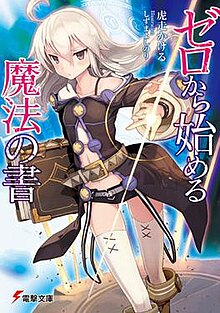
Zero kara Hajimeru MahÃ… no Sho, volume 1.jpg
Grimoire of Zero is a very familiar story. It's a medieval world where magic is real, and our heroes are a mercenary fighter and a witch. They should be enemies, but find a way to work together. There's a girl disguised as a boy, witch hunts by ignorant/frightened people, and an evil mastermind. About all that makes this setup different from a thousand others is that the fighter is a beastman, but really any kind of defect/failing that made him a bit of an outcast from society would have worked just as well. And to be fair, the story in the last couple of episodes does veer a bit off the "defeat the evil mastermind" track.

Usually I don't really enjoy shows/books/etc that are very predictable or derivative. But something makes Grimoire of Zero work for me. I think most of it is the relationship between the main characters. It progresses from mutual suspicion to a business arrangement to respect to real friendship (with bumps along the way, of course). That relationship progression is still very predictable, but it's handled nicely and both parties are likable.

It also helps that Grimoire of Zero is well produced, with good artwork and voice acting. And there's very little fluff - at only twelve episodes, there's not a lot of room for anything that isn't part of the main story. There's some minor digressions in the usual anime way - jokes about food, annoying middle-school-level sexual innuendo - but they're short. I'm fairly sure I'd have liked it much less if there had been lots of filler, but keeping the storyline moving meant I didn't have time to lose interest.

If you like the sword-and-sorcery anime genre, it's worth giving Grimoire of Zero a try.

Sunday, October 29, 2017

The Wolf at the End of the World by Douglas Smith

The Wolf at the End of the WorldThe Wolf at the End of the World by Douglas Smith
My rating: 4 of 5 stars

The Wolf at the End of the World takes stories from indigenous North American cultures and brings them to life in a modern fantasy world where the spirits are real. Smith mixes modern life and the spirits from the stories together smoothly to tell a story of world-threatening danger.

This is a story about the interaction between the modern world and a spirit world that has been all but forgotten. A few Ojibwe elders still remember the old ways, and there are a few shapeshifters, or Heroka, who live in secret and have direct links to the spirits. But the Heroka are caught between a government agency that fears them from the modern world, and malevolent spirits bent on world devastation from the spirit world. The oblivious destruction of the natural balance by ignorant humans have given those spirits an opportunity that could mean the end for humanity.

A variety of relationships develop throughout the story: family ties, the bond between lovers, the close-knit communities of the Ojibwe people and the Heroka, the Heroka's partnerships with their totem animals. All the main characters are well rounded and developed, both the heroes and villains (and it's not always clear which those are).

I enjoyed Smith's writing style, which kept just enough action in the early going to keep things interesting, then built to a whirlwind of activity in a climactic final confrontation. There's plenty of good dialog, and the occasional humorous interaction (mostly involving the young Heroka Caz) breaks up some of the serious tension.

There's some fairly obvious cultural commentary in the book. Greed of the white man upsetting the natural balance is a central theme. Younger generations leaving behind their cultural roots, fear and hatred of those who are different, abuse of power against minorities...plenty of clear warning messages. But it never felt to me as if Smith was preaching, rather just letting the results of bad choices come to light.

I thought The Wolf at the End of the World was a solid story and an enjoyable read, though the concept of bringing old stories to life isn't particularly original. It's a good implementation of that well-trodden path, though, well worth a look.

Tuesday, October 17, 2017

Envy of Angels by Matt Wallace

Envy of Angels (Sin du Jour, #1)Envy of Angels by Matt Wallace
My rating: 4 of 5 stars

"Everyone else sees a legion of undead clowns worshiping a giant chicken, right?" If that sentence makes you want to read more, then Envy of Angels is the book for you.

If the modern world was home to fantasy races (goblins, demons, etc), and they had formal events just like normal folks, then they'd need someone to do the catering. That's the basic premise behind the Sin du Jour series, of which this is the first book.

Wallace writes with a light and humorous style, suited perfectly to the fantastic-but-not-too-serious subject matter. I ran across quite a few lines worth a chuckle, and the parody of a certain segment of the fast-food industry is great.

I enjoyed all the characters, though none had a lot of depth. That's not surprising in a fairly short book with quite a few different characters. I haven't yet read further into the series, where I expect one would learn more about many of them.

I'll be seeking out more of the Sin du Jour series. If the later books are as good as the first, I'll go through them all and be looking for more.

Friday, October 13, 2017

Cracked! A Magic iPhone Story by Janine A. Southard

Cracked! A Magic iPhone StoryCracked! A Magic iPhone Story by Janine A. Southard
My rating: 4 of 5 stars

I wasn't entirely sure what to expect from a book with "Magic iPhone" in the title, to be honest. Urban fantasy, to be sure. An immortal elf, not too surprising. Set in Seattle, that fits (if not as obvious as Silicon Valley would have been). And less-than-ideal romance, sure, that works in any story. But there's less focus on either the magic or the technology than I would have expected.

The focus of Cracked is much more on relationships, particularly the three main characters. Morena and Suzyn dominate the first half, and Magic Guy (that's the aforementioned elf, who is fine with the nickname) makes it a trio later on. Morena spends a lot of energy on romance, but that's not really what the story is about. It's about friendship, and realizing that while everyone may need someone, traditional romance isn't the only solution.

There is magic involved in the story, of course, but it doesn't dominate. Morena and Suzyn never even acknowledge that it exists. The iPhone of the title plays a large role in driving the plot, but it's not until late in the book that the magic is really front-and-center. For most of the story, there could have been no magic at all, if you allow for some pretty strange coincidences.

The novel is set in Seattle in 2013, and there's a lot of specific references that make sense in that context. I suppose in 50 years it might be difficult for younger folks to relate, but right now it works just fine. It certainly helps if you're familiar with the Pacific Northwest, but I don't think it's necessary. Enough is explained that anyone should enjoy a good portion of the references, even if some of the more subtle things go unnoticed.

The story is a fairly quick read, and easy to follow. There's not much in the way of page-turning action or suspense, but the characters are enjoyable and well defined. I found myself happy to keep reading to find out what they'd do next. Give Cracked a try, and you'll likely find yourself doing the same.

Tuesday, October 10, 2017

Blood Blockade Battlefront

Blood Blockade Battlefront is an anime series about an alternate New York where a hole to another dimension has turned the city into a crossroads for all kinds of non-humans, mixing with the human population. A magical barrier keeps the intersection between our world and "Beyond" contained, preventing the two dimensions from destroying one another.

Poster
The protagonist in Blood Blockade Battlefront is Leonardo Watch, an unremarkable human except that his eyes have been replaced by a powerful artifact that lets him see nearly anything, no matter how well hidden or disguised. He got those eyes when an unknown entity took his sister's sight in exchange, and he's in New York looking for answers and to find a way to help her. Leonardo joins a group called Libra, a secret society that works behind the scenes to curb dangerous magic and non-human attacks. The other members are much more skilled in terms of fighting prowess, but Leonardo's vision is a huge asset in tracking down threats. He also meets a brother-sister pair who call themselves White and Black, who have a similar history to his own.

There's a good balance in Blood Blockade Battlefront between advancing the plot, developing characters, humor, and action. Some shows focus on one or two of those things largely to the exclusion of the others, and that can work fine, but I appreciate that the writers put the effort into using all those aspects. The humor in particular is often understated and dry, but fits in well, usually at the expense of one character flaw or another. Action encompasses not just fighting but also other scenes, like high-speed chases. Actual fighting is largely limited to the combatants shouting names of their "secret techniques" at one another. Not my favorite style, but it's not over-used here so I can put up with it.

Blood Blockade Battlefront reminds me a bit of Monogatari, in a few different ways. Both deal with confronting supernatural threats outside the public eye, use some pretty strange visual aspects, and have occasional weird perspective shifts. All of this is much less pronounced in Blood Blockade Battlefront than it was in Monogatari, though. The character types and development felt similar to me, too. However, there's no harem aspect and more action in Blood Blockade Battlefront, which is all to the good. If you liked Monogatari, there's a good chance you'll like Blood Blockade Battlefront too.

I enjoyed this first series of episodes for Blood Blockade Battlefront, and look forward to the second set later on this year.

Friday, September 22, 2017

Orconomics: A Satire

Orconomics: A Satire (The Dark Profit Saga, #1)Orconomics: A Satire by J. Zachary Pike
My rating: 5 of 5 stars

Since it's right in the title, it's no surprise that Orconomics: A Satire pokes fun at the high fantasy genre. It's more than just a parody, though, with some interesting extrapolation of what could happen when such a world runs into some of the more sophisticated and manipulative ideas of the modern world.

The world that Pike has built in this novel has all the familiar underpinnings of high fantasy. Many races - Elves, Dwarves, Goblins, and so on - roam the land. Wizards throw fireballs and delve into forbidden magic. Kings and queens and various heirs to thrones are (at least nominally) in charge. Heroes of all stripes go on quests of all kinds. A pantheon of gods, some modern and active, others ancient but never totally forgotten, are served by temples and priests. The author makes quite a few references to other such worlds - Tolkien's Middle-Earth, role-playing games like D&D - so there's no doubt of the foundations.

This world, though, has progressed further than the typical high fantasy setting. Technology is mostly the same, largely in the medieval era, but other areas of society have innovated. The hero profession has been institutionalized and drives the economy. Powerful financial houses invest in heroic quests and wield great economic and political power. Manufacturing of magical items is done at scale with assembly-line techniques. Traditionally evil races (orcs, goblins, etc) have begun to integrate into society.

The story follows a small company of largely disgraced heroes, who are forced together by circumstance to join the followers of a mad goddess. Motivated by the opportunity to regain their status in society, the group takes on a quest and stumbles through repeated danger. Interpersonal relations in the party are tense at best, but improve over time, and eventually the group works together well enough to complete their task. At which point it all falls apart, setting our heroes against pretty much all of society.

I liked pretty much all of the main characters, who start largely as fantasy stereotypes and then develop more depth. I thought Pike did a fine job capturing the feel of a misfit adventuring party, and then giving the reader reason to care about each of the less-than-perfect characters. Even the least likeable (for me, the "bard") have redeeming moments.

Pike's writing style fits nicely into the story and setting. There are a few awkward placements of jokes that fall flat (at least for me), but that could just be differences in sense of humor. On the whole, I found the book to move along at a good pace with plenty of interesting happenings along the way.

Orconomics was a fun read, though I suspect anyone not familiar with high fantasy worlds might feel a bit lost at some of the references. Pike is writing a sequel, which I'm certainly interested in taking a look at once it's finished.

Sunday, July 23, 2017

Middle-earth: Shadow of Mordor

First-person action brawlers aren't really my thing, but I can be persuaded to play them if the theme is interesting. And themes don't get a whole lot better than the Lord of the Rings universe.

Shadow of Mordor cover art.jpg
Middle-earth: Shadow of Mordor came out last year, which makes it a fairly new game for me to be playing. There's a sequel on the way soon, which of course means good deals on the original, so I picked it up for just a few bucks in a recent sale. I played it on my PC, though it's available on just about every gaming platform.

The story takes place in the time between the Hobbit (when Bilbo finds the One Ring) and the start of the main story in Fellowship of the Ring (when the Fellowship starts their quest and the War of the Ring begins). The main character is a ranger named Talion, who used to patrol parts of Mordor before Sauron and his minions began to reclaim it. He's haunted/possessed by a mysterious elven spirit, giving him all kinds of interesting abilities. Learning about that spirit makes up a good chunk of the storyline.

Shadow of Mordor does several interesting things as far as combat mechanics. There's the usual assortment of physical attacks - sword for melee, dagger for stealth, bow for ranged - but everything can be augmented by special spirit abilities. You can drain enemies of their energy to replenish ammo, for instance, or have your spirit augment melee attacks to stun enemies. Lots of blood and gore while beating up orcs, too, of course. I'm not particularly good at these kinds of first-person action combat mechanics, so it took me a while to get the hang of it, but eventually I got fairly decent at taking on hordes of orcs.

There's quite a bit of Middle-earth flavor in the game, which I really liked. You can find various artifacts with bits of lore embedded, each of which has a bit of story attached. There's small silvery runes called Ithildin to collect, which unlock portions of a image similar to the hidden Moria door. And throughout the main story there are references to the larger world, from references to coming war to an appearance by Gollum. They do take some liberties with the world that may upset some of the Middle Earth purists out there, but I don't mind that sort of thing, figuring I can just ignore the bits that don't seem to fit.

As Talion goes around Mordor, he'll run into stronger enemy leaders that are tougher to kill. These captains and war-chiefs are unique, and they'll remember if you run from them or if they kill you. They get more powerful over time, too. You can even find special missions to defeat captains who defeated your friends (assuming you're playing online and linked to a friends list). Those encounters add some extra depth to the kill-'em-all gameplay mechanics. And eventually you can use spirit domination to bring some of them around to your side, which adds a whole new facet to your fighting style.

There are some extras beyond the main story, mainly combat challenge modes. I didn't really mess around with most of that, since the combat wasn't the draw for me anyway. I was there for the story and Middle-earth world. I'm sure players that are more into the combat would enjoy them, though.

I had a great time roaming around Mordor in Shadow of Mordor. Well worth playing for any Tolkien fan, or if you like the gameplay style. If you like both, all the better!

Tuesday, July 18, 2017

Re:Zero − Starting Life in Another World

Last year, Re:Zero − Starting Life in Another World was one of the more popular anime series to air. I caught up with it on Crunchyroll recently.
A silver-haired girl against a medieval-style city. She is wearing a white robe with eagle motifs emblazoned on the sleeves. A gray cat is hovering in the air behind her. The series' title is superimposed across the front in Japanese, with the circled number ① in the upper left-hand corner.
The series follows a boy named Subaru who is pulled from our world into a fantasy land. He welcomes the change and assumes he'll get fantastic powers like the stories he's read, but instead he remains basically himself. The only power he seems to have is that dying sends him back to a previous point in time, reliving hours or days, but he can't tell anyone about it.

I like those concepts - the involuntary time jumps, interesting fantasy world, a hero who isn't an amazing prodigy at combat. Through the initial discovery phase of the series, as Subaru learns about the world and figures out his time jumping power (or curse), it all works together pretty well. The way he manages to ingratiate himself to some fairly powerful people bends the limits of credulity, but that's not uncommon in these kind of stories.

Unfortunately, then the series bogs down. Entire episodes are spent largely listening to Subaru complain about how powerless he is. Characters that were central to early episodes disappear entirely, both friends and enemies, while others pop up almost at random. Even Subaru's main love interest Emelia is absent from large stretches of the series. Hard to do any real character development when everyone but Subaru is constantly fading in and out of the story. And very little progress is made on understanding mysteries that were introduced in the early going.

The last few episodes get back on track, for the most part. There's some moderately interesting action, particularly in the whale fight, and some of the problems laid out earlier are resolved. It still feels like quite a bit is left undone, though. Perhaps there's more complete resolutions in the manga, but in the anime the story feels unfinished.

I watched all of Re:Zero because of the interesting hooks - the time jumps, a comparatively weak hero, exploration of a new world. Sadly, the execution doesn't hold up to the promise. If the hooks sound like your thing, try it out; otherwise, you're probably better passing it up.

Monday, February 13, 2017

The House of Daniel by Harry Turtledove

The House of Daniel: A novel of wild magic, the great depression, and semipro ballThe House of Daniel: A novel of wild magic, the great depression, and semipro ball by Harry Turtledove
My rating: 5 of 5 stars

There's a lot of baseball in The House of Daniel, but not the kind you may be familiar with. The book is set around the time of the Great Depression, which for baseball players meant that a lot of the lower-level minor league professional clubs folded. Semipro teams featuring local players who happened to live in the area were the norm, as well as barnstorming traveling teams - some with big-name players since they didn't get paid millions like today's stars. Outside of one organized tournament, the baseball in this book is the kind played by a traveling team against a different small-town semipro team every day.

Money, or lack thereof, is a constant theme - unsurprising in a Great Depression-era story. Jake "Snake" Spivey, our narrator, is grateful for his athletic ability to play center field well enough to earn money at it, since other jobs aren't easy to find. Even so, the opportunity for a little extra cash leads him to fall in with the wrong crowd. He gets lucky when the House of Daniel traveling team happens to need a center fielder after an injury, giving him a chance to make better money while also leaving behind some of his own problems.

As is usual with a Turtledove book, there's a lot of actual history mixed in with the more fantastic elements. There was a traveling team called the House of David which formed the basis of the House of Daniel team, and many of the towns and ballfields are based on those that actually existed back in the 1930s. References to the wider world are sprinkled through the book, from mention of the "War to End War" (this being before WW II) to Weeghman Park (our narrator not yet knowing that it was renamed Wrigley Field).

The world of The House of Daniel is also one of magic, where wizards work alongside engineers and vampires roam the night. This affects the story only in fairly minor ways, aside from one big dangerous event around the middle of the book. Most of the time, Jack takes the magical side of the world in stride and describes it no differently than the more mundane aspects. Honestly, I didn't think the magical aspects added anything to the story - you could have replaced it all with equivalent mundane activities without changing much. But it doesn't hurt, either, and I'm guessing Turtledove enjoyed putting in zombies and elementals and chupacabras.

As a fan of both baseball and alternate history novels, not to mention just about anything Turtledove has ever written, The House of Daniel was right up my alley. I had a great time reading about the little details of the team's games as well as following the larger story arc. Those who aren't as much into either baseball or the concept of an alternate history may find that the amount of detail is overwhelming, but that won't bother those familiar with how Turtledove works.

Tuesday, January 10, 2017

Among Others by Jo Walton

After I'd read The Just City, I thought I'd look up some other books by Jo Walton. Among Others is a stand-alone novel that won several awards a few years ago, so it seemed like a good place to start.
The book is set in Great Britain around 1980. It follows about a year in the life of Mor, a girl raised in Wales who is now going to school in England, after running away from her mother and being sent to stay with her father. She's partially crippled from the same accident that killed her twin sister and the smartest in her class in everything but math, in addition to being an outsider - not a good formula for fitting in at a new school. On top of that, Mor also can see fairies and do magic, unlike almost everyone else around her.

The magic in Among Others isn't flashy or ritualized. Mor isn't throwing fireballs around or creating enchanted swords. She mostly follows the advice of the fairies at first, but over time learns to do things on her own. Magic is a matter of taking specific small actions - scattering leaves at a particular time and place, carrying certain sticks and stones, even acupuncture. The results change the world, but not in any way that's obviously connected to the original actions. Mor mostly avoids using magic except defensively, in fear of unexpected consequences.

She needs that magical defense against her mother, who uses magic liberally and is constantly chasing more power. Her daughters have stopped her before, which caused the accident that killed one and crippled the other. Mor's aunts try to control her as well. A good amount of Mor's energy is spent simply trying to avoid being caught in the machinations of her relatives.

The entire book is written from Mor's viewpoint, as entries in a journal. It works well to give the reader a deep understanding of Mor's character, and how she grows and changes over time. However, the single viewpoint also made me wonder how the story might have sounded from another perspective - say, her mother. Perhaps things wouldn't be quite as black-and-white as they appear.

A major coping mechanism for Mor is reading science fiction and fantasy novels. There are references to all kinds of books from The Lord of the Rings to the Pern series to Zelazny's Amber series, and many more besides. I've read probably two-thirds of the books mentioned, so there was a good amount of nostalgic impact. When I ran across a reference that I didn't know, I felt a bit of a loss of connection to the story and Mor's character. I suspect that anyone who hasn't read a lot of pre-1980 SF/F will find it hard to be immersed in Among Others, due to wondering about the constant unfamiliar references.

There's not really a lot going on in Among Others in terms of plot. "Girl goes to unfamiliar school, grows up a bit, settles some personal demons" is a fair summary, but of course that's not the point of the book. Don't expect to see much in the way of action, mundane or magical. Mor's growth and how she copes with changes in her life drives the story.

I enjoyed reading Among Others, though I'm not sure how much of that was due to the story itself and how much was about nostalgia from all the book references. Either way, I'm happy to have had the chance.

Monday, December 5, 2016

Fiction River: Unnatural Worlds

Fiction River is a series of anthologies from WMG Publishing. The first one published was Unnatural Worlds, back in 2013. I recently read it after picking it up in a Storybundle.
Before getting to the stories, a bit about the publication. In the foreward/introduction, editors Dean Wesley Smith and Kristine Kathryn Rusch write about the (then new) idea of Fiction River. Both had worked in publishing in the past, decided it wasn't for them, and had solid success as authors. But the rise of crowdfunding via the Internet mitigated the financial risk of putting together an anthology project, and the editors were able to commission stories by authors from their own personal networks. Fiction River is a good example of new technologies driving innovation in an established industry.

I was pretty sure going in that many of the twelve stories would be solid since I recognized the authors. And this was in fact the case, with names such as Esther Friesner and David Farland, plus stories by each of the editors. I'd not encountered most of the other authors before, but given the experience of the editors, I wasn't surprised to find that I enjoyed most of their stories as well.

While the theme of the anthology is stories that deal with different worlds, the stories treat that theme very differently. Some are literal, such as Devon Monk's Life Between Dreams, where the characters actually walk across multiple worlds. Others are more symbolic, dealing with characters that come from different worlds, such as Ray Vukcevich's Finally Family.

My personal favorite is Esther Friesner's The Grasshopper and My Aunts, which was fairly predictable since I've read a bunch of her books. It's written in Victorian-era style and deals with Greek myths living in the English countryside. Quick moving and humorous throughout.

I like the idea of the Fiction River anthology series, and there's plenty more of them by now. Unnatural Worlds is a good opening effort. I'll probably seek out some more of them in the future.

Tuesday, November 29, 2016

Necessity by Jo Walton

Necessity is the final volume of Jo Walton's Thessaly trilogy. After finishing The Just City (more on it here) and The Philosopher Kings (more on it here), I picked up Necessity from the local library.
There's a gap of a few decades between the end of The Philosopher Kings and the beginning of Necessity. The cities have adjusted to their new planet (called Plato, unsurprisingly) and a new generation has grown up there. They've met two different alien races, and within the first few chapters receive communication from other humans, the first since leaving Earth. That re-contact is the subject of a lot of discussion, but isn't the primary subject of the book.

Much of Necessity is about exactly that - necessity, in the sense that the gods are bound by necessity to certain courses of action. There's a lot more about the nature of the gods, the flow of time, and the universe at large in this book than either of the others. Apollo, Athene, and an alien god are central figures in this book, taking a direct hand in much of the story.

The viewpoint characters in Necessity are almost entirely new. Other than Apollo, none of them were the narrators in the prior books. I particularly liked that Walton used Crocus, one of the sentient machine Workers, as a viewpoint character in several chapters of this book. It was also nice to see the viewpoint of Jason, who is a "silver" citizen (practical work rather than the philosophy and leadership of the "gold" citizens) on Plato. The majority of the prior two books were written from the perspective of "gold" citizens, so that perspective was a bit different.

Unlike the first two books, Necessity doesn't end with a major shakeup affecting the Platonic cities. Appropriate for the final book in the series, but I'll admit that it felt a bit anti-climatic. After the way The Just City and The Philosopher Kings ended, I kept expecting some kind of bombshell in the last few chapters of this book. We do see the that aforementioned re-contact with other humans, which is certainly important, but it's not in the same class as the splitting of the city or relocation to a new planet.

The Thessaly trilogy won't be for everyone, but for those who enjoyed the first book, finishing out the series is well worth the read.