Captain Marvel is a fun watch, like most of the MCU movies before it. Not the best, not the worst, but well executed. Certainly not worthy of the hate coming from the more misogynistic corners of the Internet.
If you've seen any of the promotional material for the movie, you already know pretty much what Captain Marvel is about. Just in this trailer alone you see that there's a woman with military background who somehow gets superpowers and hooks up with Nick Fury (beloved from lots of previous MCU movies) in the 1990s to do some kind of superheroing. And that's what happens - you will not be surprised by anything important in this movie. No "Infinity War" style twists in this one.
I'm a DC comics nerd at the detail level, but for Marvel I'm more at the "general knowledge" nerd level. She was one of my favorite characters in the Marvel Heroes MMO action RPG (may it rest in peace). So I know who Captain Marvel is, and some general stuff about her origin, but not chapter and verse of every little detail. Between that general knowledge and promo material like the trailer, I found the movie to move somewhat slowly as it went through lots of setup about the character. Par for the course with an origin movie, so I was prepared, but still a little boring.
The good news is that even knowing what's coming, Captain Marvel is still entertaining. I liked Brie Larson's performance, they did a good job cutting 25 years off Samuel L. Jackson's look, and the supporting cast does a fine job. (Particularly Ben Mendelsohn as the Skrull leader.) I loved the costume they came up with for her, except that silly mohawk helmet thing, but I suppose you have to give something to the traditionalist comics people. Lots of special effects eye candy, especially near the end. Which is only what I've come to expect from the MCU.
You're not going to miss the big themes of this movie. A determined woman overcoming "a girl can't do that" prejudice: not only do we see tons of this from the main character, you've also got her best friend, honorary niece, and even one of the top enemy fighters pounding that theme home. The fact that the timeframe is 20 years ago: if Blockbuster and Radio Shack isn't enough, there's all kinds of music and culture references scattered about. People aren't what they may first seem - spoiler territory, but it's everywhere. I have no problem with any of it, but be warned, don't expect subtlety.
There was a lot of hate for this movie across the Internet before it even came out, and that continued through the opening weekend. I'm happy to say those idiots were wrong; a female lead is just fine for a superhero movie (not that anyone who's seen Wonder Woman is surprised by that). I kinda wish the creators had gone further - imagine if they'd swapped roles for Larson and Lashana Lynch (who plays her black best friend). I bet the movie would be just as good, and would have caused even more coronaries among the kind of morons who hate on movies for who they feature.
I'd put Captain Marvel firmly in the middle of the MCU movie universe...solid effort that's better than some and worse than others. For an origin movie, it's hard to complain. And I really look forward to seeing Carol Danvers kicking some serious tail in future films.
Showing posts with label movie. Show all posts
Wednesday, March 13, 2019
Thursday, March 7, 2019
Marshall (movie) and Young Thurgood (book)
Young Thurgood: The Making of a Supreme Court Justice by Larry S. GibsonMy rating: 3 of 5 stars
I didn't know much about Thurgood Marshall outside what everyone learns in history class: civil rights hero, argued Brown v. Board of Education, later Supreme Court justice. At the local library, I came across a couple of ways to rectify my ignorance: the 2017 movie Marshall, and the book Young Thurgood by Larry Gibson. The book fills in much of the backstory that led to those great things, covering the first 35 or so years of his life. The movie is a dramatization of a rape case that took place in 1940, pretty much right after the time covered by the book. I read the book first, then watched the movie.
There's a lot packed into Young Thurgood about Marshall's early life, but two major themes stood out for me. First, Thurgood Marshall had an incredible work ethic. He was constantly busy with activities, whether those took the form of work or education or community service. Second, Marshall had a true belief in the importance of civil rights activism and put that above his own welfare. This is most clearly demonstrated in the way that he repeatedly took civil rights cases over more lucrative law practice options, despite his own tenuous financial position.
Beyond the details of Marshall's life, the other theme that struck me in reading Young Thurgood was just how pervasive racism was in the early 20th century. Everything from lesser pay to school restrictions to lynchings...reading example after example really drives home how bad things were only a century ago. We've still got plenty of work to do on this front, but it's also striking how much things have changed. And Thurgood Marshall had a large role in making those changes.
Young Thurgood isn't a novel; there's a lot of fairly dry recounting of history to get through. There's not a lot of excitement in the documentation of individual incidents, but taken as a whole, the book does a fine job of painting a picture of Marshall and the early 20th century.
The movie Marshall, on the other hand, struck me as very much the opposite - very entertaining, but light on the historical accuracy. It strikes me as extremely unlikely that Marshall would have been quite so high-handed with Sam Friedman as is shown in the film, for instance. Making Friedman carry his bags, really? Being cavalier about little things like changing radio stations or sending Friedman into the mud? It works for setting the Marshall-in-charge dynamic for the film, but I highly doubt the accuracy. But that's not surprising, in a film that's largely about showing Thurgood Marshall as a civil rights superhero. He deserves the acclaim, exaggerated or not. And I enjoyed catching references to many of the people that I'd just read about in the book.
I'm never going to be a Thurgood Marshall expert, but I feel like I know a little more now about the man and his work. Time well spent.
Saturday, June 9, 2018
Solo: A Star Wars Story
Solo: A Star Wars Story is a decent movie. Not a great one, as I suspect many fans were hoping; and not a terrible one, as much of the Internet would have you believe.
Solo is an origin story for Han Solo, that lovable rogue from the original Star Wars films. Starting from his lowly origins as a orphaned urchin on Corellia, Han talks and fights his way into and out of any number of improbable situations on his way to becoming the smuggler we know. Along the way we see him meet Chewbacca and Lando Calrissian, and of course find the Millennium Falcon.
I went into this expecting to see how Han met Chewie, and maybe some other stuff. Which is pretty much exactly what I got out of it. Just about everything involving Chewie was great...I particularly liked that he rescued another Wookie at one point...and the rest of the movie was decent, but nothing spectacular. They filled in a few gaps (like what exactly the Kessel Run was) and expanded on the smuggler's underworld that Han inhabits. Sure, there were some silly bits (like making the marauders into a proto-Rebellion) but I'm used to that with Star Wars. (Midichlorians, anyone?)
I didn't think any of the actors did an exceptional job, but none of them were terrible either. Donald Glover was the best of the bunch as Lando, but his role was too minor to really stand out. Alden Ehrenreich is no Harrison Ford, but that would be true of just about anybody, and I thought his Han was solid but not particularly noteworthy. Neither Woody Harrelson nor Emelia Clarke impressed me much with their performances, but it's not like they were terrible. Just kinda mediocre.
The writers clearly tried to interject some social commentary into the film, most notably with Lando's droid L3-37 (oh, haha, what a clever name) agitating for droid rights. Which, in my opinion, fell completely flat because they couldn't decide whether it should be a serious issue or comic relief. Going back and forth between the two failed miserably.
There's been a ton of angst all over the Internet about how Solo had a poor performance at the box office. I doubt Disney is losing much sleep over that, because they're still going to make millions overall (merchandise, DVD sales, etc). And even if they do lose some money on this one, the Star Wars franchise isn't in danger any time soon.
For Star Wars fans, it's worth seeing Solo for a bit more story about characters that you already know. You'll likely have a good time watching, but I doubt you'll find much that stands out.
Monday, April 30, 2018
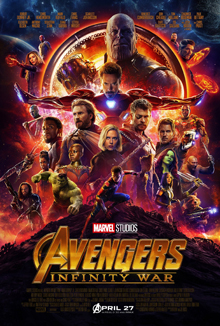
Avengers: Infinity War (spoilers)
Been keeping up with the Marvel Cinematic Universe (MCU)? Hope so, since pretty much all of it shows up in Avengers: Infinity War.
Whatever themes in the MCU movies you may have liked, you'll probably find bits of it in Infinity War. Star-hopping shenanigans from Guardians of the Galaxy and Thor, time bending from Doctor Strange, alien invasions from the earlier Avengers films, Wakandan technology and home turf defense from Black Panther, and so on. If it feels like a bunch of different pieces stitched together, that's because it basically is.
The general arc of the plot is pretty easy to follow for the theoretical viewer who hadn't seen any other MCU films, as best I can tell. Big bad guy is gathering nasty weapons and killing people, try to stop him. But there's a lot of detail that would be missing. Most of that is in terms of character development - there's very little because all the time is being spent on jumping back and forth between all the different groups of heroes doing their separate things. In that way, Infinity War is more like a television series season finale than it is a stand-alone movie.
And like many good season finales, Infinity War ends on a cliff hanger. The heroes don't win, lots of people die, the bad guy is happily retired. Which is very different from the vast majority of MCU films, at least if you think of Infinity War as a stand-alone movie. But it's really part one, with a second part scheduled to come along in 2019. That will be the first episode of the next season, to continue the television series analogy, resolving that cliffhanger and setting things up for the next big storyline.
Like almost all big-budget films that I've seen in the last decade or so, I thought Infinity War was about 30-40 minutes too long. Plenty of character bits that were clearly there just to call back to the earlier movies could have been skipped. Stuff like Drax's "invisible" scene, or some of the Tony-Peter banter...not enough there to define the character relationships, just reminders of what we already know. And of course just about all the fight scenes are extended to show off more explosions and special effects. A bunch of that stuff could have been cut from the theatrical release and put into a director's cut, in my opinion. And was it really necessary to put the post-credits teaser scene (which sets up the Captain Marvel movie) at the very end of the credits?
Despite those annoyances, Infinity War is a fun ride, particularly if you've kept up with all the other MCU films over the last decade or so. It certainly did the job of setting up for the next Avengers film.
Saturday, February 17, 2018
Thor: Ragnarok
It occurs to me that Marvel Studios has set a really high bar with their MCU movies. Thor: Ragnarok is a solid effort, well above average and miles better than anything that I'd have expected a decade or so ago. And yet I found myself disappointed.
(Warning: Spoilers below, on the off chance that anyone else is as late to the party as me.)
This is the third Thor movie, and the seventeenth in the MCU. All the usual things that I've come to expect from MCU movies are here: impressive effects, interesting characters, plenty of interpersonal drama, and a plot that holds together if you don't think too hard about it. There's plenty of appearances by other Thor-adjacent characters, most notably Loki and Odin from earlier films, and new introductions of their long-lost sister Hela and a new Valkyrie ally. The Hulk plays a big role as well, which is nice since he's been missing since Avengers: Age of Ultron. And there's a bit of Doctor Strange, following up from the teaser bit at the end of his movie.
So why the disappointment? First, my expectations were sky-high. Several people in my circle of friends raved about this movie, calling it the best to date in the MCU and possibly the best superhero movie of all time. Critics loved it, ratings were high, hardly a bad thing to be said about it anywhere. Thus, I was expecting incredible things. When I got only above-average, it felt disappointing, even though I know that's not really fair.
Second, the primary reason that I think Thor: Ragnarok falls short of excellent and thus below my expectations: the overdone, constant slapstick humor. The first few times it's funny: someone falls flat on their face, accidentally knocks themselves over, insults their opponent to his face, etc. But after you see it again and again, you start to expect something embarrassing, and then it's just tiresome. By the time Bruce Banner does a belly flop out of a spaceship near the end, it was so obvious what was coming that I was cringing. Clearly I'm in the minority on this, given how much everyone else seems to love the movie, but the humor aspects just felt excessive to me...and it's not funny when it's overdone.
There were a few other minor things that didn't click with me. Jeff Goldblum's Grandmaster character annoyed me, largely because I felt that Goldblum's style clashed with the role of manipulative, heartless tyrant. The loss of Mjolnir (that's the hammer) felt almost trivial in how easily it happened. The mighty Thor begging Stan Lee not to cut his hair was pathetic. And there wasn't nearly enough of Fenris (the giant wolf).
Having said all that, Thor: Ragnarok is a fine movie. I'm glad that I've seen it, and likely will watch it again someday when I happen across it on a streaming service or something. Don't avoid it, just temper your expectations a bit going in.
Sunday, September 17, 2017
Hidden Figures (movie)
I'm a sucker for pretty much anything to do with space travel. Hidden Figures takes place at NASA in the 1960s, so it definitely falls into that category. But it's the extraordinary story of black women overcoming racial and gender stereotypes that really drives this film.
As a computer nerd with a moderate interest in history, I'd heard of Dorothy Vaughan, a supervisor and self-taught programmer who worked with the first computers at NASA. Only the basic outlines, though, without much of the personal detail that the movie shows. And the stories of Katherine Johnson and Mary Jackson were entirely new to me.
There's a lot of casual racism and sexism portrayed in the film, as you'd expect when the setting is the early 1960s. In quite a few spots, I found myself thinking "I'm sure glad we're past that" - segregated fountains, separate coffeepots, refusing to let a woman into meetings, colored-only bus seating, etc. But then there were other parts that I think haven't changed as much as I'd like. Mistaking Katherine for a janitor, for instance. Or high-level decisions being made in meetings consisting entirely of white men. Anyone who thinks that society has moved past the issues portrayed in this film needs to look a bit more closely - there's been progress, but there's still plenty to be done.
The tension of the space race and cold war is worth noting, too. For people of my generation and older, it's not all that remarkable - we grew up with the Soviet Union always out there, with nuclear holocaust looming if either side blinked. But anyone who can't remember the world before 1991 has never known that tension, so references to "duck and cover drills" and the fierce patriotism felt by the entire country when opposing the Soviets has got to be an alien concept. I thought the movie did a good job of portraying this, though of course I'm not exactly the target audience.
As with most historical movies, not everything is perfectly accurate. I'm no expert, but I did read a few articles afterward about where the movie made some changes. From what I found, I think the film makers did a fine job of making sure the concepts were communicated, even when they couldn't use the exact people or events. And when they did follow the historical record, everything I read said that they did an outstanding job.
I really enjoyed Hidden Figures, and recommend it to anyone. I hope it's a part of inspiring the next generation of mathematicians and engineers, regardless of who they are or what they look like.
Monday, June 12, 2017
Wonder Woman (2017)
Bringing a female superhero to the big screen in a leading role hasn't been done often, but DC did a solid job of it with Wonder Woman.
Unsurprisingly, Wonder Woman is an origin story. The character appeared briefly in Batman v Superman: Dawn of Justice, and the entire movie is basically a flashback sequence from that modern-day version of Diana. The entire movie takes place in the past, specifically the World War I era. If that sounds familiar, it's because Marvel did more or less the same thing with Captain America. It's hard to really fault the writers for copying, though, since all these superhero movies have their roots in decades of comic book stories, many of which are very similar. Hard to really say who is copying what, with all that history.
I felt like the movie did a good job of setting up Diana's past, explaining the role of the Olympian gods and her home of Themyscira. Seemed to me that there was enough explanation to make sense to a non-comic-nerd, though I admit that it's hard to tell since I am one. There have been lots of versions of Wonder Woman over the years, and this one seems as good to me as any.
Gal Gadot did a fantastic job as Diana, and I thought the writers and director captured the character very well. Diana's naivete is very clear as she makes her first foray into man's world, but she never seems weak or lost because of it. There's very little sexual content, which isn't easy when your main character is a gorgeous woman running around in skimpy battle costume. There's a fine line to walk with this character, and I think they did an outstanding job.
I wish I could say the same about the action scenes. There's constant use of slow-motion sequences in the middle of the action, and just about every one of them annoyed me. The scenes themselves were fine, well designed and executed. I particularly liked the no-man's-land advance, with Diana playing the "tank" for the soldiers. I just wish the director hadn't been so in love with slowing the action down over and over again. It's fine to do that once or twice, to call attention to some particularly impressive feat or important small detail, but it was badly over-used here.
The plot and minor characters are serviceable, if not particularly impressive. The "twist" with Ares' identity and the god-slayer weapon was so heavily telegraphed that I hesitate to even use the term. Outside of Steve Trevor, other characters are present only as opportunity to show off some aspect of Diana. But none of that is surprising, as it's hard to do much in an origin story film outside of the main character without making things too complex to easily follow.
Wonder Woman is a big step forward for the DC cinematic universe. I know we'll be seeing more of Diana, and I look forward to it. I hope to see more of this quality of writing, directing, and production in the future DCU movies as well.
Labels:
comic-book style,
DCU,
movie,
video
Wednesday, April 5, 2017
Ghost in the Shell (2017)
I recently went to see Ghost in the Shell (the 2017 movie). While it wasn't as bad as reviews have been making it out to be, it certainly could have been a whole lot better.
As I've said previously, I'm a big fan of the Ghost in the Shell franchise. Which made it difficult to see this kind of movie without preconceptions - I have all sorts of assumptions about the characters and world rolling around in my head. And the movie didn't make it easy to disconnect, as it went out of the way to throw in all kinds of references to the original movie, SAC series, etc. But I did do my best.
If I think of this movie as the origin story for a human-android hybrid in a cyberpunk world (trying to ignore previous incarnations of the franchise), then it's not terrible, but not good either. The plot, revolving mostly around the Major's self-discovery, is adequate but doesn't have a lot of depth to it (to be fair, that's not uncommon in an origin-style film). The writing is just downright poor, I'm afraid. They do too much "tell, not show" - for example, the entire opening sequence showing the prosthetic body creation and then explanation by the doctor fell flat for me. Why not have that information be revealed naturally as the story goes along instead of just laid out in unimpressive dialog? The action is merely adequate as well - some of it is interesting (I enjoyed the last big fight, for example), but also there are some cringe-worthy slow-motion shots that probably spiked the CGI budget for no good reason.
Then there are all those Ghost in the Shell franchise references. They are absolutely everywhere, from the Major dropping off a building and disappearing (twice) to a chain-smoking technician to Batou's dog. It felt to me as if someone took a big handful of iconic components from all the franchise properties and said "Use as many of these as possible, whether they make sense or not." Some of it does fit in without disrupting the flow of the film, but other parts just make no sense. Even the name (or title?) "Major" is never really explained and just seems out of place.
For me, the constant references jarred me out of this new version of the franchise by reminding me of the older works (and the contrast between the two). The feeling is doubled when they made changes that seemed to have no purpose. For example: Aramaki is out in the field on his own near the end, and using a revolver. Why not have Togusa there with him and using that gun, as in pretty much all the other versions? It's not like Togusa had anything else to do at that point in the story.
The casting is worth a mention here, since it's gotten a good amount of negative attention. This is a Japanese series and there are a lot of white faces in the cast, most notably Scarlett Johansson in the lead role. That didn't bother me too much, since the whole premise of the movie is that she's not in her original body. The city that they are in is pretty clearly Asian but with a very cosmopolitan feel, so it doesn't seem out of place that there are non-Asian people roaming around without causing comment. Still, it seems like an unnecessary controversy since I'm sure there are plenty of actors of Asian descent that could have performed just as well. I wish the producers would have taken a different direction from the beginning.
This Ghost in the Shell movie had a lot of potential, but squandered it with poor writing and way too many incongruous franchise references. I'm guessing we won't see any follow-up to this particular version, which is probably just as well. A great live-action movie is possible for this franchise, but to get there someday they'll need to start over from scratch.
Labels:
Ghost in the Shell,
movie,
video
Tuesday, December 27, 2016
Rogue One
It takes some extra skill to put together a story when everyone already knows the ending. I think the Rogue One folks did a fine job.
This newest Star Wars film takes place prior to A New Hope. It follows Jyn Erso, the daughter of an engineer forced by the Empire to work on the planet-destroying Death Star. She and various rebellion irregulars track down her father, discover that he has sabotaged the project, and go into the lion's den to get the details to the Rebel Alliance.
We've already known for nearly four decades how the story is going to end, since A New Hope starts with the Death Star plans already in the hands of Princess Leia. (RIP Carrie Fisher...the news of her death broke on the same day I saw this movie.) Rogue One takes full advantage of the fact that nearly every viewer is going to know that story. There are lots of familiar people and places and things that show up as Jyn's story unfolds, from C-3PO and R2-D2 to Darth Vader to the princess herself (pretty decent CGI on that). The journey doesn't end happily ever after for everyone, which might have been depressing if we didn't know what comes next.
Having said that, I also enjoyed the story that Rogue One told beyond just looking for the ways that it links to the larger Star Wars story. Jyn is a flawed heroine, involved in the conflict more for revenge and following her father than for the ideals of rebellion. Just about everyone that accompanies her on her journey is a misfit or outcast of some kind. The story is as much about those misfits coming together to get a job done as it is about setting up A New Hope.
One thing you don't see much of in Rogue One is Jedi. There are references to the Force, and one character who has at least some Jedi skills, but this story takes place in the time when Darth Vader has largely exterminated the Jedi Order. It's a stark contrast to most of the other Star Wars films, where being or becoming a Jedi is almost always a central theme. I was pleased to see that Rogue One worked out well without them.
Just about anything Disney puts out under the Star Wars name is going to make plenty of money, but between Rogue One and The Force Awakens, it seems they're trying to make decent movies as well as cashing in. As long as they keep that up, I'll keep watching them.
Wednesday, November 23, 2016
Doctor Strange (2016)
I caught the latest Marvel superhero movie today, Doctor Strange, at the local AMC theater.
I was pretty surprised to be charged exactly $5.19 for my ticket. I'd heard that some theaters were doing flexible pricing these days, but this was the first time I'd seen it in action. The 11:30 AM Wednesday show (not in 3D) was apparently pretty low on the demand scale. As someone who almost never goes to a theater during peak hours, I approve heartily. I also approve of the recliner-style seating that this particular theater was equipped with, took full advantage of that.
Doctor Strange is an origin story, like most of the other MCU productions featuring a character for the first time. Like most comic book nerds, I knew the basic story already: egotistical surgeon gets into an accident, loses his ability to perform surgery, goes searching for help and finds a mystical world where he becomes a hero. The movie does a fine job going through that origin, even if it feels a bit rushed as Strange goes from inept neonate to battle-sorcerer.
The movie is almost entirely about developing Strange's character, and there's not a whole lot of room for others. The renegade-sorcerer villain is a single-minded, one-dimensional character intent on his path of destruction. The supporting cast of other doctors and magicians mostly just seem to emphasize one aspect of Strange's transition: his old love and professional lives, the mentors leading him into magical domains, the previous master falling to make room for him. I don't think this is a bad thing, since the whole idea is to tell Strange's origin, but it's worth mentioning.
There are a whole lot of special effects in this movie, and they sure seemed well-executed to me. All the MCU films have plenty of CGI muscle behind them, and this one is near the top of the list in sheer amount of visual effects. In several places the entire screen is full of shifting landscapes - even if you haven't seen the movie yet, you've probably seen it in all the commercials - while various characters bounce around, fighting each other and dodging the scenery. A bit overdone, perhaps, but it's certainly impressive.
As with most MCU films, this one has some small tie-ins to the larger universe. Avengers Tower shows up in the New York cityscape, there's mention of an Infinity Stone, and if you stay past the first bit of the closing credits a certain Avenger makes Strange's acquaintance. I'm looking forward to seeing Strange mixed in with the rest of the MCU.
Given the prevalence of sweeping special effects, I'm glad I saw Doctor Strange in the theater. I'm sure it'll look fine on a small screen too, but those kind of visuals have a bigger impact on the big screen. Especially for $5.19.
Labels:
comic-book style,
MCU,
movie,
video
Friday, September 2, 2016
Batman v Superman: Dawn of Justice
Every once in a while, Google sends me an email offering a discount on digital movie rentals. I used the most recent one on Batman v Superman: Dawn of Justice.
I didn't go to see Batman v Superman in the theater when it came out earlier this year, largely because the reaction from my friends that did ranged from "meh" to "avoid at all costs." So I went into this with a pretty low set of expectations. There were two major complaints: the iconic characters weren't portrayed as expected, and the way the movie unfolded just didn't make a lot of sense.
Batman is pretty easily my favorite comic book character of all time. Not even close, really. I've enjoyed all the various versions over the years, from the campy Adam West TV show to comics through the 80s and 90s to the Christopher Nolan films. Which is a bit of a long way to say that I don't really care about staying true to any particular "iconic" version. Same goes for Superman and just about any other character. The fact that this movie showed a Batman didn't seem to mind killing a few bad guys, or a Superman that is more conflicted than bright-and-shiny undaunted hero, doesn't bother me much.
I do, however, care about a movie's plot, characters, action, and setting flowing together to make an entertaining whole. On this front, I'd say Batman v Superman was pretty awful. The entire plot hangs on one thing: Lex Luthor is nuts, while at the same time being incredibly smart and manipulative. Batman and Superman both come off as chumps, maneuvered by Lex into fighting one another. I thought it would have been a much better movie without them getting into any kind of fight at all. Meanwhile, Lex is busy creating some uncontrollable monster, clearly just as bad for him as for anyone else - insanity at work. Unfortunately, basing the entire plot on the workings of an insane mind does nothing for narrative flow - things just sort of seem to happen for no reason other than to put a big fight in the spotlight.
If I had to pick a single word to describe Batman v Superman, it would be "clumsy." You can see what the writers and director are trying to do, but it just falls flat. Lex's manipulations only make sense if the heroes are stupid, distracted, or both. The romance between Clark and Lois is assumed from the very beginning, and then a bunch more scenes build it up later...as if we don't already know they're lovebirds after the very first rescue. Other Justice League characters pop in for a scene or two, adding exactly nothing to this movie (other than Wonder Woman) - an incredibly clumsy way to tie into a larger movie universe. Even the big fight scenes feel as if they were choreographed by the special effects people for the most spectacular shot, regardless of how silly that makes the actual characters look. And the character design is nothing special even outside of poor action choreography - Doomsday in particular looks terrible.
Despite all that, there were still some good things to come out of Batman v Superman. I enjoyed Ben Affleck's portrayal of Batman, and Jeremy Irons did a pretty decent Alfred. Gal Gadot did a good job as Wonder Woman, actually fitting better into the story than anyone outside of Batman - certainly better than the cameos by other Justice League members. Gives me hope for future movies, as long as some lessons are learned instead of just repeating the mistakes.
If I'd seen this movie 10 years ago, it's possible I'd have liked it a lot more. But now, I've got the entire Marvel Cinematic Universe to compare it against, and that's not flattering for Batman v Superman. With luck, future DC movies will be better.
Labels:
comic-book style,
DCU,
movie,
video
Thursday, June 30, 2016
Fantastic Four (2015)
Another movie off the watchlist via HBO NOW - the 2015 version of Fantastic Four.
No one seemed to like this movie much when it came out, which is one reason I hadn't bothered watching it until now. So I started with low expectations, which I think actually helped. I knew not to expect a faithful comic-series adaptation, or an amazing adventure with stunning special effects.
This version of the Fantastic Four is basically a group of young explorers, working on a way to cross into another dimension. They're working with Franklin Storm (father of the brother-sister Storms in the four) and another young scientist in Victor von Doom. Add in a smarmy corporate executive type and you have pretty much the whole cast.
None of the characters felt like they had much depth. What character development there was seemed to be trying to shoehorn them into the Fantastic Four mold - Reed's friendship with Ben, Sue and Reed growing close, Victor jealous of Reed. It all felt very predictable, even though these characters are different from the traditional comic cast. Seems like there were two different aims here - a different take on the Fantastic Four characters, and keeping familiarity for fans - and the result is that neither is done well.
Notably lacking is any significant attempt at humor, and it's sorely missed. I think the aim was to make a serious, suspenseful movie, but that's hard to do with superheroes. Everyone already knows more or less what will happen...world is in trouble, world is saved. The audience stays more engaged with a chance to laugh every once in a while.
Superhero movies rely pretty heavily on special effects and action scenes, and Fantastic Four is at best mediocre in both. It takes half the movie for there to be much in the way of either. The effects are pretty much what I expected, which isn't good...that means nothing was impressive enough to stand out. As for action, it's almost all concentrated into the final battle, which was completely predictable. Bad guy is strong, heroes are in trouble, heroes suddenly realize they can work together, big win. Yawn.
I think this could have been a decent movie if it wasn't about the Fantastic Four. Take the same general plot and tone, but make it about a smaller unfamiliar set of characters/powers, and you'd have a science fiction heroic adventure. You wouldn't need to split screen time trying to develop four different heroes, and their relationships could be a surprise to the viewer. Add in some improved action sequences, and it could be a much better film. Unfortunately, that's not how it worked out.
Labels:
comic-book style,
movie,
video
Monday, June 27, 2016
The Martian
I've been able to knock a few movies off my to-watch list with the HBO NOW subscription I picked up for this month. Latest in the list - The Martian.
The simplest way I can think of to describe The Martian is Robinson Crusoe meets Apollo 13. You've got the "lone survivor against a hostile environment" aspect of Crusoe, and the "scramble madly to put together a rescue plan in space" aspect of Apollo 13. The writers did a good job of interweaving the two. The survival aspect is more prevalent early, gradually giving way to the grand rescue later on.
I didn't notice any specific time references, but the film is clearly meant to be set in the near future. There's a lot of implied technology advances, enough to get manned missions to Mars with some pretty advanced survival gear. But it stops well short of near-magical technology like warp drives or teleportation. With the assumption of slightly-advanced technology, it's pretty easy to suspend disbelief over some of the less probable activities that happen in the course of the film.
Outside of the space program, the world is clearly recognizable as a mirror of our own. NASA still has to deal with Congress and public opinion, China is a rival on the world stage, crowds gather in Times Square, and so on. The politics and public opinion have some pretty major impacts, affecting the decisions made on the way to the rescue mission. One bit in particular stood out for me - when the Chinese space program officials decide to keep communication "scientist to scientist" rather than get the politicians involved. A none-too-subtle jab at the likelihood of international cooperation in the political arena, even in an emergency situation.
Matt Damon was excellent as the stranded Mark Watney, which is a good thing since he has a whole lot of screen time with no one else around. I also really liked Jeff Daniels as NASA Director Teddy Sanders. That character has to make some really hard decisions, and though he comes off as the bad guy in some ways, I thought Daniels' portrayal conveyed a real desire to do the right thing for the space program as a whole.
The effort put together to rescue the stranded astronaut is massive, which I think the film captures as well as possible in a limited time. There are a lot of references to how much work NASA has to put in with the rescue mission, some comments about the astronomical cost, and the Chinese program loses a planned mission as well. Many months are covered in the space of a couple of hours, which is never easy to properly convey in a way that feels real to the audience. There's one huge multi-month jump near the end of the movie, but other than that the movement of time is handled pretty smoothly.
In the end, the whole world is watching and cheering on the rescue mission. I didn't notice any direct reference to this in the film, but it struck me that there were probably thousands of people on Earth dying preventable deaths while the world was focused on the spectacle on Mars. Perhaps there's a bit of subtext there that isn't explicitly stated - it's amazing what can be accomplished with dedicated effort and resources, but only if they can be brought to bear.
I'm glad that I had the chance to watch The Martian. Well worth spending 2.5 hours to see.
Friday, June 17, 2016
Mad Max: Fury Road
Aptly named, this film.
Mad - Yep, we got crazy. Max is kinda nuts, with random people from his past popping into his head regularly. It's heavily implied that he's seeing members of his family that he failed to save, and he's been less than sane since. (Possibly someone who had seen the previous three Mad Max films would recognize some things in those flashbacks, but I haven't watched them.) And the world at large is pretty crazy, being a post-apocalyptic wasteland.
Max - Protagonist named Max, check. Tom Hardy does a fine job in my opinion - not an amazing performance, but that's all right since the character doesn't really do much outside of a whole lot of stunts. Max isn't your usual hero material, what with the insanity and all. The evolution of his relationship with the other lead character, Charlize Theron's Furiosa, doesn't feel all that crazy, though. Max goes from captive to mutually suspicious no-choice-but-to-work-together travel companion to trusted fellow warrior/leader/perhaps love interest. No surprises there.
Fury - Just about everyone's angry about something. Furiosa and her escaping girls are mad about mistreatment (with cause, I'm sure). Max is angry that he was taken captive and lost his car. The bad guys are pissed about the escapees, some other bad guys are mad that their underhanded deal got wrecked, and so on. Plenty of fury to go around.
Road - So many post-apocalyptic wasteland vehicles to blow up, so little time! There are a whole lot of high-speed chase and battle scenes, mostly with all kinds of explosions and fire. The action is well executed in my opinion. I like exploding vehicles as much as the next guy, and these kept me entertained the whole way.
Mad Max: Fury Road delivers exactly what it promises - lots of action in a post-apocalyptic dystopia. The plot and characters are there mostly to support the action, and do that well. You can read some deeper themes into the story - mistreatment of women, dangers of a cult-like society, you can't go home again - but I prefer to take it at face value as a fast, fun ride.
Labels:
movie,
science fiction,
video
Sunday, June 5, 2016
Jupiter Ascending
Jupiter Ascending is a science fiction space opera. Lots of special effects, various aliens, threats to end the world...the usual.
The story follows Jupiter Jones, a Russian immigrant girl in Chicago who happens to be the genetic reincarnation of a space queen. Various people show up to capture or kill her, she falls in love with a hard-bitten mercenary type, many things explode, and in the end she goes back to her plain-old-Earth-girl life. It's about as engrossing as it sounds, which is to say, not at all.
Which is too bad, because I think Jupiter Ascending had some promise. There's certainly plenty of action, and the effects seemed mostly to be well done. The sound effects could have used some more work, I thought, since all the high-tech alien weapons sounded like they came out of a cartoon. But the visuals were solid, and no more ridiculous than what you see in every movie of this kind.
As a backdrop, the idea of a universe run by mostly-immortal humans intent on living forever didn't seem too terrible. Their plan to "harvest" the Earth by turning everyone into immortality-body-wash makes an interesting way to threaten the planet, but I never really felt any suspense over the possibility.
Largely that was due to the villains being incredibly bland and inept. Three siblings take a run at getting Jupiter-reincarnated-as-their-mother to either join them or go away, but none of them felt like a serious threat. Even the guy who steals Jupiter's family and holds them hostage was so transparently planning to wipe out the Earth (and them with it) that it was impossible to believe that she'd ever go along with him.
The heroes weren't much better. Jupiter pretty much just wanders around wherever people lead her, gets into trouble, and waits for Caine (the mercenary-type guy) to save the day. For his part, Caine has basically no personality, but of course he can survive anything and overcome any obstacle. There are hints of more interesting character development, such as Jupiter being desperate enough for money to sell her egg cells to a fertility clinic, or Caine's need to belong to a larger organization. But after establishing those things, there's not really much in the way of followup.
You expect over-the-top heroics in space opera, but usually there's some attempt to surprise the viewer with a twist or two. I didn't feel like any of that happened in Jupiter Ascending. Maybe I'm just jaded from seeing too many stories of this type, but this one didn't stand out in any way. Every step along the way felt predetermined.
Jupiter Ascending isn't bad, exactly, just generic and uninspired. The world-building was serviceable, the characters did what they needed to do, the special effects were pretty...but none of it made me want to see more. If you like the genre and you happen to have the opportunity, Jupiter Ascending is worth watching. But I wouldn't go out of my way for it.
Labels:
movie,
science fiction,
video
Thursday, May 26, 2016
Deadpool
No one who might be offended by <insert just about anything> should see this movie. It certainly deserves its R rating.
OK, now that we've got that out of the way, Deadpool is incredibly good. Ryan Reynolds nails the lead role as Wade Wilson, making believable the foul-mouthed, constantly wise-cracking anti-hero. I've yet to see Morena Baccarin turn in anything but an excellent performance, and her Vanessa is no exception. And Ed Skrein does a fine job as the unfeeling villain of the piece.
Deadpool is all about the comedy, which makes sense given the character's comic-book background. Everything is joke, from the one-liners thrown around in battle to Wade trading insults at the bar. At times the humor is directed to the audience, "breaking the fourth wall", which I thought were some of the best bits. Even the romance between Vanessa and Wade was largely based on them tossing jokes back and forth. It works well in all cases, which is a tribute to both the writing and acting.
The plot is probably the weakest point of Deadpool. "Revenge against the guy who ruined your life, and oh look he's holding your girlfriend hostage" is about as unoriginal as it gets. I didn't really care, though, because the movie is about the characters, action, and humor. A complicated plot would actually have gotten in the way.
There's a whole lot of over-the-top violent action scenes in this movie. Not quite at the level of red-food-coloring-everywhere that you might see in a Tarantino film, but close. Deadpool's constant wisecracking makes these scenes comedic as much as they are violent action, though. I thought it was technically well executed. There are a few uses of slow-motion and such, but the special effects aren't over-used.
This film belongs to the X-Men film universe (as opposed to the MCU), and it does include a couple of other X-Men characters: Colossus and Negasonic Teenage Warhead (no, really, that's the name...it's not a Deadpool joke). But Deadpool is an origin story movie for Deadpool, and doesn't really cross over with the other X-Men films. Except to make a few jokes at their expense, of course. Also, Stan Lee as a strip club DJ was an inspired way to make use of the cameo he makes in every Marvel film.
Deadpool isn't a movie you can recommend to everyone. The viewer can't be too uptight about language, violence, or sex. But that viewer also doesn't have to know anything about superheroes or comic books to enjoy it, which I think is a major reason for the film's great box office success. I really enjoyed it, and hope they can pull off the same kind of performance for the sequel.
Labels:
comic-book style,
movie,
video,
X-Men
Tuesday, May 10, 2016
Captain America: Civil War
Marvel Studios films have been some of the best action movies released in the last decade. Captain America: Civil War fits right in.
I really dislike crowded theaters, so I didn't go to see this movie on opening weekend. By waiting until the first Monday showing, I got into a theater that was only about 1/3 full. Most of that population was a high school class, I assume seeing the movie as a reward of some kind. The teacher had to shush them a few times, but nothing too distracting. And the theater had a few rows of D-BOX seats, a few rows ahead of where I was sitting. I could feel the vibrations all the way back where I was. Can't imagine why you'd want to pay extra to sit in the actual seats, but I suppose there's always someone looking for extras in the movie experience.
Two and a half hours used to be a really long running time for a movie, but it seems pretty average these days. Captain America: Civil War doesn't feel artificially extended like some films, though. The story flows smoothly the entire way through. Nothing seemed totally out of place, disconnected, or felt like a last-minute addition. And it fits in nicely with the rest of Marvel Cinematic Universe films, with plenty of references to previous events.
That story involves a manipulative villain setting the heroes at one another's throats, as you'd expect from a movie with "civil war" in the title. The plot mechanics involving the mystery villain were well executed, neither revealed too quickly nor made too obscure. All that was really secondary to the personal conflicts between the various heroes, though. Primarily this takes the form of Iron Man versus Captain America, with other heroes lining up behind one or the other. It's not always easy to portray friends falling out, and I'm glad to say that all the actors involved pulled it off nicely here. Scarlett Johansson's Black Widow was particularly well done in my opinion, as she tries to walk the line between her friendship with Cap and agreement in principle with Iron Man.
Before things get intensely personal, conflict between the two sides is about oversight for the Avengers. The Iron Man position is that superpowers need to be kept in check, no matter how well-meaning the people using them. An international agreement through the United Nations is presented for the heroes to sign, binding them to obey UN direction on when and where they can get involved in world events. Captain America's side fears that such restrictions will put them in a position of being unable to intervene when they feel it's necessary, or worse used as enforcement for corrupt regimes. It's not always smart to put too much thought into the philosophical underpinnings of superhero movies, but in this case I think it holds up pretty well. The tension between using force where required and keeping that force in check is an issue in the real world, not just some larger-than-life super-conflict. I thought Captain America: Civil War did a good job of calling attention to that tension, and showed how each side has positive and negative points. The question isn't ever truly resolved, which is a good thing since you can't fully resolve it in the real world either.
Though I try not to know too much about any movie before seeing it for the first time, I'd already seen some important scenes from this one. All it takes is one trailer or commercial, so I knew ahead of time that we'd see Spiderman and a big showdown between Iron Man and Captain America/Winter Soldier. I understand that the marketing folks want to drum up as much interest as possible, but I wish they'd found a way to avoid showing important late-movie stuff in the pre-release promotional material. The aforementioned showdown is the last big scene, and based just on what you see in the film, you'd think the in-fighting was over and everyone was friendly again (despite still having some disagreements). It kind of spoils the surprise when you know they're going to end up fighting again because it was in all the commercials.
Speaking of commercials, I noticed a good amount of product placement. That's nothing unexpected in today's film world, of course, but it can still be a bit jarring at times. Mostly I just noticed things in passing, such as the (very) old-school Mac in Peter Parker's room, or the VW Bug that Cap drives at one point. But the Vivo logo on smartphones was a bit much, particularly at the top of Tony Stark's super-futuristic holo-tablet. On the other hand, seeing MSNBC on the news reports with Kate Snow anchoring fit in nicely and added a bit of a real-world feel.
A lot of any superhero movie is about action, and there was plenty in this one. I'm sure that I'd find some things to nit-pick after seeing it again, but on first viewing it sure seemed extremely well done. There's plenty of action set in areas all over the world, from an early incident in Nigeria to the final showdown in Siberia. The centerpiece is a big hero-on-hero fight involving every major player on both sides, and it did not disappoint. Every character had an opportunity to put their signature on the fight, from Ant-Man shrinking down to mess with Iron Man's suit to Spiderman talking incessantly through the action.
Even if you haven't seen the previous MCU films, Captain America: Civil War is well worth spending the time to see. If you have, it's even better. Action fans should like it, and superhero fans should love it.
Labels:
comic-book style,
MCU,
movie,
video
Monday, April 11, 2016
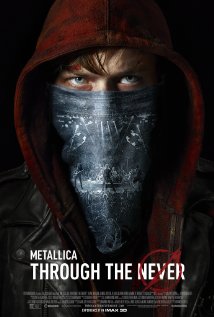
Metallica's Through the Never
A few years ago, Metallica created a movie, Through the Never. I heard about it at the time, but didn't pay a whole lot of attention. The opportunity to watch it came up recently, so I took a couple of hours to check it out.
I had basically no pre-conceptions going in, since all I knew about Through the Never was that Metallica was involved. I wasn't sure if it was a documentary, or live concert, or what. Turns out, it's pretty much a 90-minute music video, with a large amount of concert footage included.
There's a storyline, kind of, where a roadie goes out to find a missing truck while the concert is going on. All sort of surreal stuff happens, from riots in the streets to the guy setting himself on fire. There's almost no dialog or explanation, which is one reason the movie feels like a music video. Seems to me that weirdness-on-screen while the music plays is a music video staple. The story bits weren't bad, but I didn't feel like they really added much to the experience.
The majority of the screen time isn't the roadie story, though, but rather concert footage. This was really well done, with lots of good close-ups of each band member and a goodly amount of wide-view shots around the stage and crowd. Some concert footage is pretty much static, showing the same few angles over and over, but Through the Never doesn't have that problem.
I've been to a good number of Metallica shows over the years, so I recognized several of the stage tricks. Either from my own experience, or videos I've seen. The giant coffins suspended around the stage from Death Magnetic, for instance. The giant blind justice statue from ...and Justice For All, and the cemetery crosses from Master of Puppets. And most notably, the "stage collapse accident" with the burning roadie running across the stage. I saw that one in person on an earlier tour - right after Load came out, if I remember right.
As a concert video, Through the Never is pretty good. I was a little disappointed that they didn't use Seek and Destroy, but otherwise the music selection was good. It was worth spending a couple of hours on the couch. I think I'd have been disappointed if I'd gone out of my way to see it in a theater, though. If you're going to make the effort to go out and see a band, better to go to a real concert, not just a movie about one.
Saturday, March 26, 2016
The Big Short
I recently had opportunity to see The Big Short, the 2015 film based on the book of the same name by Michael Lewis. It takes place in the years leading up to the financial crisis of the late 2000s, focusing on a few groups of people that saw the problems developing.
First, the movie is definitely entertaining. The characters are all interesting, and the casting is great. My personal favorite was Christian Bale as Dr. Michael Burry, and I had no complaints about any of the other performances. It starts a bit slowly, but once all the major players have been introduced, there's always something of interest happening. It runs just about 2 hours, and I didn't feel like it dragged out at all.
I consider myself an informed layman when it comes to financial markets in general, and the financial crisis of the late 2000s specifically. Certainly I don't have the depth of understanding that a real insider would, or someone who has studied the subject extensively. But I know about sub-prime mortgages, and credit default swaps, and CDOs, and the general way that the crisis unfolded. So I didn't watch the movie as much to learn what it said about the financial crisis, as I did to see how how it said those things.
As far as explanations goes, I thought the writers did pretty well. Using humorous celebrity cameos to explain bits of financial jargon is a stroke of genius. If you have to figure out a way to get complex and dry information across to the audience, why not make it fun? That shows up in other places, too, such as the Jenga-style tower used to represent bond markets in one meeting. It's still a lot of information to understand if someone were to come in with no clue at all about the subject, but I think they did as well as can be expected with the explanations.
Having said that, there's certainly a lot of complexity about the situation that wasn't included. Do a quick search on "big short fact check" and you'll see a whole lot of people who have written about things the film glosses over, exaggerates, or leaves out entirely. I've read a few of those, and while I don't doubt that they all have their points, it seems to me that they're mostly expecting too much of a movie (or book) that's meant to give the layman both entertainment and understanding. I think the major points that the movie makes are mostly accurate, and trying to explain even more underlying detail would have added only confusion.
When The Big Short ends with some pointed comments about how little has been done to change the system, it certainly makes the viewer think. And that's exactly what you want to see from this kind of film.
Saturday, January 23, 2016
Ex Machina
Ex Machina caught my eye because it's science fiction and has a focus on artificial intelligence. It's also a psychological thriller, which isn't my favorite film genre. After watching, I'd say it's much more about the mind-games genre than it is about the science fiction aspect, but both are well executed.
Roughly the first third of the movie is spent setting up the characters. Caleb is a young programmer brought out to the remote home/research facility of his boss, Nathan. Nathan is a super-rich genius who owns a search engine company and (unknown to anyone outside himself and Caleb) has developed an intelligent android. Caleb is meant to evaluate whether Ava, the android, is truly self-aware.
I enjoyed this early part, with all the introductions and bits of background revelation. It certainly helped that I empathize with Caleb's character: smart technology guy, somewhat isolated socially, excited about the idea of artificial intelligence. The setting was also interesting, with the juxtaposition of a high-tech facility buried way out in the wilderness. And of course there was Ava herself. There's a good amount of build-up before you see her for the first time, which adds a sense of mystery, and the effects they used to create a see-through android body are pretty neat.
Once the players are all in place, the rest of the movie is about mind games played by the various parties on one another. Everything boils down to Ava wanting to survive and be free. It was mildly interesting to see how it all turned out, of course, but I found the resolution and reveal portion of the movie less interesting than the initial setup. That's just my personal bias, of course - I like the speculative fiction aspect more than the mind games.
Ex Machina poses an interesting scenario, and the movie is put together nicely, especially considering the relatively low budget. I've seen many worse movies that cost a lot more! The psychological thriller aspect isn't really my thing, but it seemed to be well executed. In the end, I'm glad to have spent a couple of hours to watch it.
Labels:
movie,
science fiction,
video
Subscribe to:
Posts (Atom)